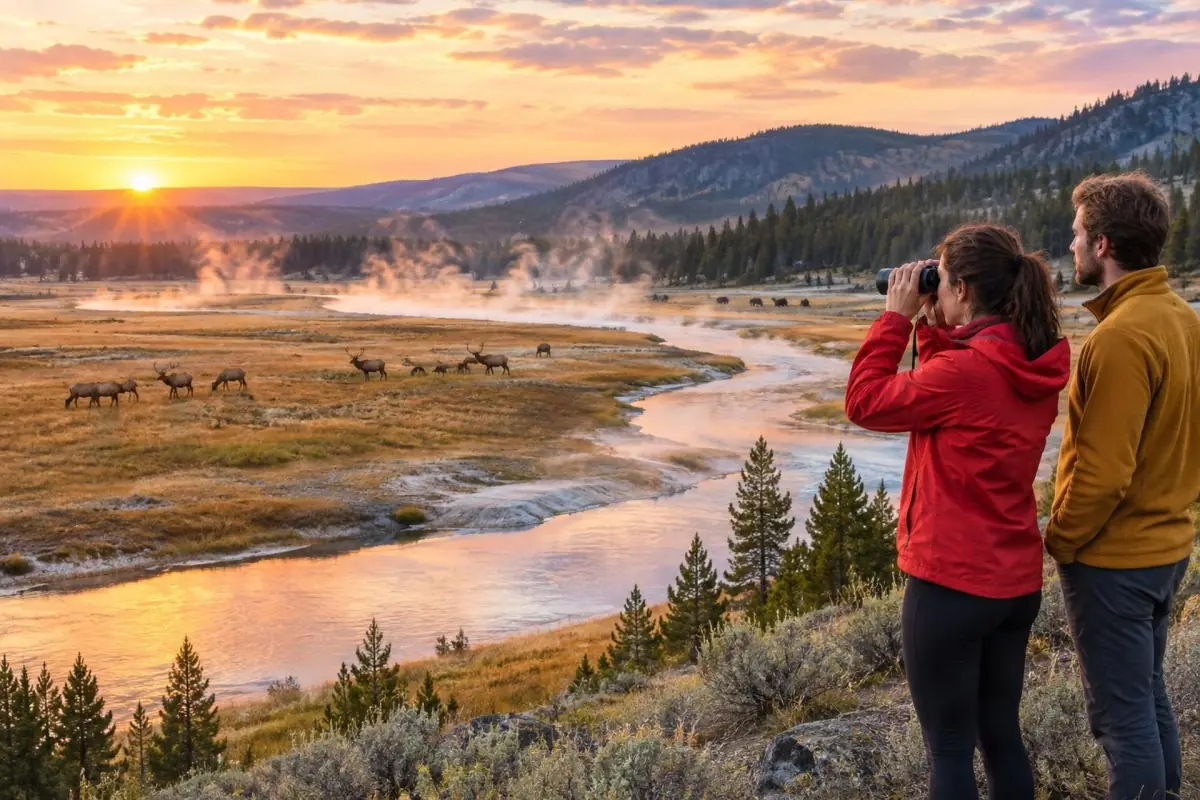
A Yellowstone wildlife tour on a geyser route
A Yellowstone wildlife tour with Old Faithful combines thermal scenery with opportunities to watch animals. The outings here are guided sightseeing circuits with binoculars and spotting scopes. Choose this format if the geyser is an essential part of the day and animal watching is another reason to travel. A sighting remains a possibility, rather than an appointment that can be placed between two stops.
The Lower Loop links the western geyser areas with Yellowstone Lake, Hayden Valley and the canyon area to the east. Its geography helps explain how a day can include both steaming ground and animal observation. Road openings, weather and animals on the road affect the journey. For a broader comparison of departure points and routes, see Old Faithful tours.
Start by matching the departure town to where you sleep. The Jackson or Teton Village outing, the Cody outing and the West Yellowstone outing serve different starting areas. Old Faithful is the destination within the park. Choosing a departure near your accommodation avoids building the day around an extra journey before the guided trip begins.
Our take
These guided drives combine Old Faithful with opportunities to look for wildlife. Choose a pickup base that fits your stay and allow for variable conditions.
Hand-picked tours, booked through GetYourGuide. Prices are indicative starting prices in US dollars (as of November 2026). Tap a tour for live availability and the current price in your currency.

Yellowstone wildlife and geyser trip
- Biologist/naturalist guide
- Picnic lunch
- Use of binoculars and spotting scopes
Park entry is extra; confirm pickup time. Wildlife sightings are not guaranteed and the route depends on roads and weather.
Check availability →
Old Faithful from West Yellowstone
- Professional naturalist guide
- Brown bag picnic lunch
- Binoculars and a group spotting scope
Confirm the hotel-lobby pickup time; park entry is extra. The overlook hike depends on conditions.
Check availability →
Old Faithful and wildlife from Cody
- Professional guide
- Hotel pickup and drop-off
- Use of binoculars and scopes
Allow 8 to 11 hours; park entry is extra, so check pass validity and international surcharges. Confirm the lunch inclusion and the alternative Fishing Bridge meeting point before booking.
Check availability →Geyser circuits with wildlife viewing
Choose Jackson or Teton Village, Cody, or West Yellowstone as your starting area. These Old Faithful outings supply viewing optics; park admission is separate.
Hayden Valley and possible sightings
Hayden Valley lies on the eastern part of the Lower Loop. The outing from Jackson or Teton Village includes Old Faithful and Hayden Valley in its itinerary, subject to roads and weather. It provides a biologist or naturalist guide, an enclosed vehicle, picnic lunch, snacks and refreshments, plus binoculars and spotting scopes. This combination suits visitors who want interpretation and viewing equipment alongside the geyser stop.
Bison and elk are also among the animals described for the Old Faithful area. Keep looking from permitted places without treating a particular meadow or time as a promise. An animal may be distant, moving or absent. For the thermal walks themselves, use the Upper Geyser Basin guide and leave flexibility around the eruption viewing.

Choose Jackson, Cody or West Yellowstone
The Cody outing includes hotel pickup and return, a professional guide, bottled water and use of binoculars and scopes. Its route visits Old Faithful and Grand Prismatic Spring. Confirm the lunch arrangement before booking because the meal instructions differ. Park admission is separate. An alternative meeting point at Fishing Bridge needs its own agreement; it should not be treated as pickup from anywhere inside the park.
The active van outing from West Yellowstone includes hotel pickup and return in that town, a naturalist guide, a morning snack and hot drink, and a picnic lunch with cold drinks. Binoculars and a group spotting scope are supplied. The route includes Old Faithful and a walk to the Grand Prismatic viewpoint, with road and weather conditions shaping the day. Park admission is separate here too.
Compare these practical differences before choosing by a wildlife photograph. Food, optics and the right departure area make the outing workable even when animals remain far away. If your party needs a dedicated vehicle, the private tour guide explains the available Lower Loop arrangements.
Distance from bison, elk and bears
Keep at least 91 m from bears, wolves and cougars, and at least 23 m from other wildlife, including bison and elk. These are minimum distances. If an animal approaches, move back rather than holding your position for a photograph. Behaviour that disturbs wildlife can still be unacceptable beyond the minimum distance. Do not feed animals, and secure food.
Optics help make distant observation useful; they do not provide a reason to approach. Give children clear instructions before a stop, and keep the whole party ready to move away together. Around geysers, stay on designated paths and boardwalks. Thin thermal crust can cover scalding water, so stepping aside for an animal or a camera angle is dangerous.
Cameras and safe stopping places
Use designated stopping and parking areas without blocking traffic or parking on vegetation. Keep tripod legs on the boardwalk and leave room for others to pass. A long lens or spotting scope allows observation from a safe position. Drone operation is prohibited in the park. The photograph is optional; a safe route back to the vehicle or along the boardwalk is essential.
Before travelling, match the outing to the road and arrival plan. A summer road itinerary should not be used as a winter access plan. For the geyser stop, current ranger information is more useful than trying to predict an eruption from the time spent watching animals.
Frequently asked questions
Are these dedicated wildlife safaris?
They combine Old Faithful and other park scenery with animal observation. The supplied binoculars and scopes support viewing from a distance, while sightings depend on the day.
Which outing picks up in West Yellowstone?
The active Lower Loop van outing includes hotel pickup and return in West Yellowstone, along with a naturalist guide and picnic lunch.
How close can I stand to a bison?
Keep at least 23 m away and retreat if it approaches. Bears, wolves and cougars require at least 91 m. Keep those distances when taking photographs.